
The 33rd China International Exhibition on Electric Power Equipment and Technology
Shanghai New International Expo Center (Hall N1 - N5, W4 - W5), PR China 2026 • 12 • 3 - 5
English
The 33rd China International Exhibition on Electric Power Equipment and Technology
Shanghai New International Expo Center (Hall N1 - N5, W4 - W5), PR China 2026 • 12 • 3 - 5
| Smart Grid Technology Trends 2026: What to Expect at Upcoming Power Conferences |
|---|

|
| Publish Date : 2026-03-04 |
|
|
|
|
|
The global smart grid analytics market has registered a compound annual growth rate (CAGR) of 12.4% during the 2025 forecast period, signaling unprecedented momentum in grid modernization efforts worldwide.[^1] As the power industry accelerates its digital transformation, upcoming conferences like EP Shanghai 2026 provide critical platforms for professionals to explore breakthrough technologies reshaping electricity infrastructure.
EP Shanghai, organized by the China Electricity Council and co-organized by Adsale Exhibition Services Ltd, has established itself as the leading electric power exhibition in China since 1986. With over 30 years of experience connecting global market leaders, EP Shanghai 2026 will gather 2,200+ exhibitors across 86,000 square meters at Shanghai New International Expo Center (Hall N1-N5, W4 & W5) from December 3-5, 2026, attracting over 75,000 trade visitors worldwide.[^2] Understanding the technology trends emerging in 2026 is essential for power professionals preparing for the next wave of grid innovation. From artificial intelligence integration to massive energy storage deployments, these developments will dominate conference agendas and investment priorities across the global power sector. Top Smart Grid Technology Trends in 2026 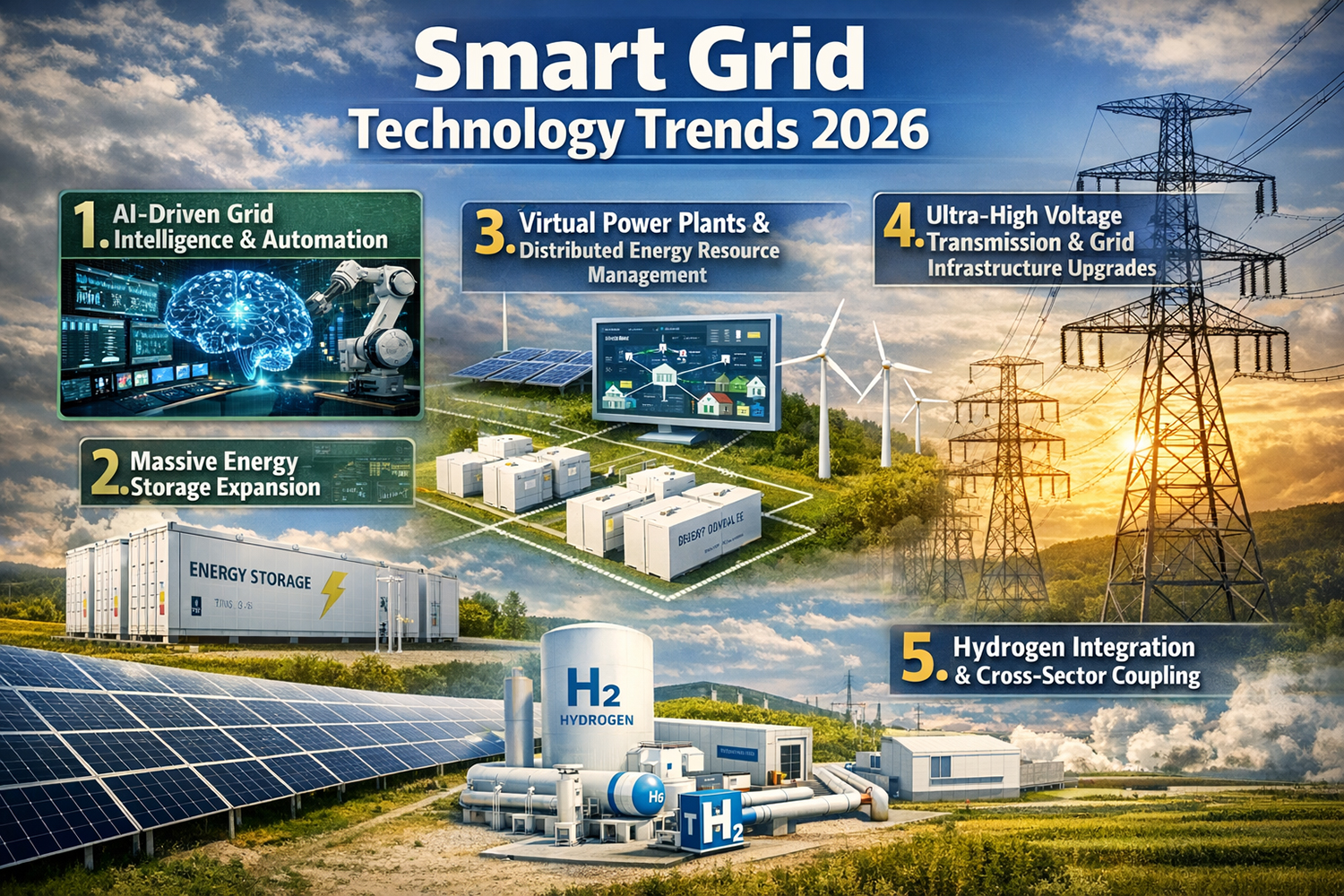 1. AI-Driven Grid Intelligence and Automation
Artificial intelligence applications in energy and utilities represent a $7.7 billion market opportunity in 2025, with North America holding the largest share of AI-powered smart grid deployments due to advanced infrastructure and robust technology adoption.[^3] AI technologies are fundamentally transforming how power systems operate, predict demand, and respond to grid disturbances.
Key AI applications reshaping smart grids include: • Predictive maintenance systems: Machine learning algorithms analyze equipment sensor data to identify potential failures before they occur, reducing unplanned outages by up to 30% • Renewable energy forecasting: AI models improve solar and wind output predictions, enabling better grid balancing and reducing curtailment • Automated demand response: Intelligent systems dynamically adjust loads based on real-time supply conditions and pricing signals • Grid security: AI-driven intrusion detection markets are projected to surge from $1.76 billion in 2024 to $2.11 billion in 2025, reflecting growing cybersecurity priorities[^4] EP Shanghai 2026 will showcase advanced AI solutions from leading Chinese and international suppliers, including virtual power plant platforms, smart dispatch systems, and digital twin technologies for grid optimization. Attendees can explore how AI-powered energy management systems coordinate distributed energy resources while maintaining stability across increasingly complex power networks. 2. Massive Energy Storage Expansion
The United States installed a record 57.6 GWh of energy storage capacity in 2025, representing a 30% increase over 2024 and four times the capacity deployed just three years earlier.[^5] This explosive growth reflects energy storage's critical role in integrating renewable energy and providing grid flexibility.
Energy storage technologies dominating 2025 deployments include: • Lithium-ion battery systems: Utility-scale installations continue leading market growth, with costs declining and performance improving • Long-duration storage: Pumped hydro, compressed air energy storage (CAES), and emerging gravity-based systems address seasonal balancing needs • Commercial and industrial storage: Behind-the-meter installations enable peak shaving, demand charge management, and backup power • Residential battery systems: Home energy storage enrollments surged 153% year-over-year in 2025, driven by virtual power plant programs[^6] China leads globally with over 59% of new energy storage installations in 2024, aiming to exceed 180 GW by 2027, nearly doubling current capacity.[^7] The long-duration energy storage market alone was valued at $964.8 million in 2025 and is projected to reach $2.72 billion by 2033, growing at a CAGR of 13.9%.[^8] At EP Shanghai 2026, attendees will find comprehensive displays of energy storage equipment, from battery management systems to advanced thermal storage with molten salt technologies supporting industrial decarbonization. The concurrent ES Shanghai 2026 (Shanghai International Energy Storage Technology Application Expo) provides focused exploration of storage innovations critical to future power systems. 3. Virtual Power Plants and Distributed Energy Resource Management
The global virtual power plant (VPP) market reached $6.28 billion in 2025 and is predicted to grow to $30.85 billion by 2033 at a CAGR of 22.6%, as utilities and aggregators coordinate distributed resources to deliver grid services.[^9] VPPs aggregate solar installations, batteries, electric vehicles, and flexible loads into controllable assets that enhance grid reliability.
VPP deployment highlights in 2025 include: • Rapid scaling: VPP deployments grew 33% year-over-year, from 1,459 programs in 2024 to 1,940 in 2025[^10] • Capacity expansion: U.S. VPP capacity hit 37.5 GW in 2025, driven by residential battery and electric vehicle integration[^11] • Market participation: VPPs increasingly participate in wholesale electricity markets, providing frequency regulation, capacity, and energy services • Residential focus: Residential battery enrollments in VPP programs surged 153% in 2025, demonstrating consumer acceptance of aggregated resource models EP Shanghai offers a unique opportunity to explore how Chinese power companies implement source-grid-load-storage integrated projects, combining renewable generation, grid infrastructure, flexible loads, and storage in coordinated systems. Exhibitors will demonstrate microgrid solutions, virtual power plant platforms, and intelligent dispatch technologies enabling these integrated approaches. 4. Ultra-High Voltage Transmission and Grid Infrastructure Upgrades
China plans to modernize and expand its power grids with $442 billion in investments over the 2021-2025 period, focusing on ultra-high voltage (UHV) transmission and inter-regional connections to support renewable integration.[^12] Grid infrastructure modernization addresses the fundamental challenge of connecting remote renewable resources to demand centers while maintaining reliability.
Key infrastructure developments include: • Ultra-high voltage DC transmission: Enables efficient long-distance power transmission with minimal losses, connecting wind and solar bases to load centers thousands of kilometers away • Flexible AC transmission systems (FACTS): Advanced power electronics improve grid stability and control power flows • Distribution network upgrades: Smart distribution automation, advanced metering infrastructure, and two-way power flow capabilities accommodate distributed generation • Black start capabilities: Autonomous wind turbine operation and grid resilience technologies enable restoration after major disturbances Chinese companies have achieved major technological breakthroughs in UHV transformers, smart grid equipment, and electromagnetic design methods, establishing China as a global leader in power equipment manufacturing.[^13] EP Shanghai 2026 will showcase these advances in power transmission and distribution equipment, with demonstrations covering the entire power industry chain from generation to end-use. 5. Hydrogen Integration and Cross-Sector Coupling
China accounts for 50% of the world's green hydrogen production capacity, with national strategies emphasizing hydrogen's role for energy storage, grid balancing, and decarbonization of hard-to-electrify sectors.[^14] Hydrogen technologies are transitioning from pilot projects to commercial deployment, particularly in wind-solar-hydrogen-ammonia integration projects.
Hydrogen applications in power systems include: • Seasonal energy storage: Converting surplus renewable electricity to hydrogen addresses long-duration storage needs beyond battery capabilities • Grid balancing: Hydrogen production can absorb excess renewable generation, reducing curtailment and providing flexibility • Industrial decarbonization: Hydrogen replaces coal and natural gas in high-temperature industrial processes, creating new electricity demand patterns • Power generation: Hydrogen-capable gas turbines and fuel cells provide dispatchable, zero-carbon generation The hydrogen value chain—from electrolysis equipment to storage systems and fuel cells—will feature prominently at EP Shanghai 2026. Attendees can explore how hydrogen technologies integrate with renewable energy projects and contribute to comprehensive decarbonization pathways. The exhibition covers hydrogen production equipment, storage solutions, and fuel cell technologies applicable to both stationary power and transportation applications. What to Expect at EP Shanghai 2026 ? Comprehensive Technology
Showcase
EP Shanghai 2026 will present the full spectrum of electric power equipment and technology across seven exhibition halls covering 86,000 square meters. The exhibition scope includes: • Electric power transmission and distribution equipment • Smart energy solutions and grid automation systems • Power dispatching and control technologies • Instrumentation and testing equipment • Low voltage electrical equipment • Energy storage systems (co-located ES Shanghai 2026) • Power solution for Data Center and Cloud Computing • Hydrogen Energy Solutions/ Equipment • Energy conservation technology and industrial power equipment (UPS, generators, alternators) With 2,200+ exhibitors and brands from around the world, EP Shanghai provides unparalleled access to equipment suppliers, technology providers, and solution developers serving the global power industry. The exhibition attracts power companies, grid corporations, project developers, engineering firms, research institutes, and industrial end-users from railway, construction, oil and gas, and other sectors. EP Shanghai complements these technical conferences with hands-on product demonstrations, business matching services, and direct access to decision-makers from major power groups and grid corporations. Business Development and Partnership Opportunities
EP Shanghai excels at facilitating business connections across the power industry value chain. The exhibition offers: • Business matching services: Connecting buyers and sellers based on specific technology needs and capabilities • Online exhibition platform: Year-round access to suppliers and product information at epchinashow.com • VIP exhibitor programs: Premium placement for leading global brands • Technical seminars: Deep-dive sessions on specific technologies and applications The exhibition attracts over 75,000 trade visitors worldwide, including procurement teams from State Grid Corporation of China, China Southern Power Grid, and the five major power generation groups, alongside international utilities, developers, and engineering firms. This concentration of decision-makers creates unmatched opportunities for launching new products, expanding market reach, and establishing partnerships. Preparing for the Smart Grid Technology Revolution
Key Considerations for Power Industry ProfessionalsPower professionals preparing for 2026 conferences should focus on several strategic priorities: 1. Grid flexibility solutions: Evaluate how energy storage, demand response, and flexible generation assets address renewable variability 2. Digitalization strategies: Assess AI platforms, digital twins, and data analytics tools that improve forecasting and operational efficiency 3. Integration methodologies: Understand approaches for coordinating distributed energy resources through virtual power plants and microgrid controllers 4. Cybersecurity frameworks: Review protection systems for critical infrastructure as connectivity and automation increase attack surfaces 5. Market mechanisms: Explore how electricity markets evolve to incentivize flexibility resources and properly value grid services EP Shanghai 2026 provides comprehensive coverage of these topics through product demonstrations, technical presentations, and consultation with expert exhibitors. Attendees can compare solutions from competing suppliers, discuss implementation challenges with peers, and identify technologies appropriate for specific applications and operating environments. Technology Selection Criteria When evaluating smart grid technologies at conferences and exhibitions, consider: • Interoperability: Compatibility with existing systems and adherence to industry standards (IEC 61850, IEEE 2030.5, OpenADR) • Scalability: Ability to expand capacity as needs grow without fundamental redesign • Proven performance: Track record in similar applications and operating conditions • Total cost of ownership: Initial investment plus operational, maintenance, and upgrade costs over system lifetime • Vendor support: Local service capabilities, spare parts availability, and technical assistance Chinese electric power equipment delivers strong advantages in innovation capability, large-scale production efficiency, intellectual property development, smart manufacturing quality control, and global reach to over 130 countries.[^15] EP Shanghai showcases these capabilities alongside international technologies, enabling comprehensive comparison and informed decision-making. Conclusion Smart grid technology trends in 2026 reflect an industry in rapid transformation, driven by renewable energy integration, digitalization, and decarbonization imperatives. The explosive growth in AI applications, energy storage deployments, virtual power plants, transmission infrastructure, and hydrogen technologies creates both challenges and opportunities for power industry professionals. Upcoming conferences, particularly EP Shanghai 2026, provide essential platforms for exploring these innovations, comparing solutions, and establishing the partnerships necessary to navigate this technological revolution. EP Shanghai's comprehensive scope, diverse exhibitor base, and strong backing from China's major power groups and grid corporations make it an indispensable event for anyone seeking to understand and participate in the future of electric power systems. As the power industry continues its transition toward cleaner, smarter, and more resilient infrastructure, staying informed about emerging technologies and implementation strategies becomes increasingly critical. EP Shanghai 2026 offers unparalleled access to the innovations, expertise, and business connections that will shape the next decade of power system development. Smart Grid Trends FAQ
Q: What are the most important smart grid trends for 2026?
A: The most significant smart grid trends in 2026 include AI-driven grid intelligence expanding to $7.7 billion in market opportunities, massive energy storage deployment with 57.6 GWh added in the U.S. alone, virtual power plant growth reaching $6.28 billion globally, ultra-high voltage transmission infrastructure investments of $442 billion in China, and hydrogen integration for seasonal storage and industrial decarbonization.[^3][^5][^9][^12][^14]
Q: How is artificial intelligence transforming smart grids?
A: AI transforms smart grids through predictive maintenance reducing unplanned outages, improved renewable energy forecasting for better grid balancing, automated demand response optimizing load management, and enhanced cybersecurity with AI-driven intrusion detection. The AI-powered smart grid market in North America holds the largest global share due to advanced infrastructure and technology adoption.[^3][^4]
Q: Why is energy storage critical for smart grid development?
A: Energy storage is critical because it addresses renewable energy variability, provides grid flexibility for balancing supply and demand, enables peak shaving and demand charge management, and supports grid resilience during outages. The 30% year-over-year growth in U.S. energy storage installations demonstrates its essential role in modern power systems.[^5]
Q: What can attendees expect at EP Shanghai 2026?
A: EP Shanghai 2026 attendees can expect to explore 86,000 square meters of exhibition space featuring 2,200+ exhibitors across seven halls, covering electric power transmission and distribution, smart energy, energy storage, power automation, and industrial power equipment. The event offers business matching services, technical seminars, and networking opportunities with over 75,000 trade visitors from power supply companies, grid corporations, and industrial end-users worldwide.[^2]
Q: How do virtual power plants contribute to grid reliability?
A: Virtual power plants contribute to grid reliability by aggregating distributed energy resources (solar, batteries, EVs, flexible loads) into controllable assets that provide grid services including frequency regulation, capacity, and energy balancing. VPP deployments grew 33% year-over-year in 2025, demonstrating their growing importance in grid operations.[^10]
Visit EP Shanghai 2026
Explore cutting-edge smart grid technologies, energy storage solutions, and power equipment innovations at EP Shanghai & ES Shanghai 2026, December 3-5, 2026, at Shanghai New International Expo Centre. Register and learn more at www.epchinashow.com. References
1: LinkedIn, "Smart Grid Analytics Market Size Trends 2025: North America," 2025. https://www.linkedin.com/pulse/smart-grid-analytics-market-size-trends-2025-north-america-6fzqf
2: EP Shanghai, "Leading Electric Power Exhibition in China," 2026. https://www.epchinashow.com/ 3: Yahoo Finance, "Applied Artificial Intelligence (AI) in Energy and Utilities Research Report 2025: $7.7 Bn Market Opportunities," 2025. https://finance.yahoo.com/news/applied-artificial-intelligence-ai-energy-120800669.html 4: BusinessWire, "$4.3 Bn Artificial Intelligence (AI)-Driven Smart Grid Intrusion Detection Markets 2019-2024, 2024-2029F, 2034F," 2025. https://www.businesswire.com/news/home/20260114720350/en/%244.3-Bn-Artificial-Intelligence-AI-Driven-Smart-Grid-Intrusion-Detection-Markets-2019-2024-2024-2029F-2034F---ResearchAndMarkets.com 5: Solar Energy Industries Association (SEIA), "Energy Storage Market Outlook," 2025. https://seia.org/research-resources/energy-storage-market-outlook/ 6: PV Magazine USA, "Ohm Analytics 2025 VPP market report reveals 21% growth in overall capacity," 2026. https://pv-magazine-usa.com/2026/01/27/ohm-analytics-2025-vpp-market-report-reveals-21-growth-in-overall-capacity/ 7: EP Shanghai, "Latest technology innovations in China's power industry," 2025. https://www.epchinashow.com/ 8: Grand View Research, "Long Duration Energy Storage Market Industry Report, 2033," 2025. https://www.grandviewresearch.com/industry-analysis/long-duration-energy-storage-market-report 9: Grand View Research, "Virtual Power Plant Market Size, Share Industry Report 2033," 2025. https://www.grandviewresearch.com/industry-analysis/virtual-power-plant-market-report 10: Uplight, "Virtual Power Plants Are Powering the Grid of the Future," 2025. https://uplight.com/blog/virtual-power-plants-are-powering-the-grid-of-the-future-and-uplight-is-leading-the-way/ 11: Electrek, "EVs and batteries fuel the US VPP boom, hitting 37.5 GW in 2025," 2025. https://electrek.co/2025/09/19/evs-batteries-us-vpp-boom-2025/ 12: International Energy Agency (IEA), "Smart grids," 2025. https://www.iea.org/energy-system/electricity/smart-grids 13: EP Shanghai, "Main advantages of Chinese electric power equipment," 2025. https://www.epchinashow.com/ 14: EP Shanghai, "Latest technology innovations in China's power industry," 2025. https://www.epchinashow.com/ 15: EP Shanghai, "Main advantages of Chinese electric power equipment compared to other countries," 2025. https://www.epchinashow.com/ |
 Firefox
 Chrome
 Safari
 QQ
QQ Edge
Edge